


Social Media Skyrockets Mental Health Awareness
- Oct 16, 2020
- 3 min read
Updated: Nov 12, 2020

Cause and Effect
It is no doubt that social media has become an important aspect of our society, especially for the youth of America. Generation Z teens are consumed by it. They use social media for news, to connect with friends, find job and education opportunities, and more recently raise awareness about important political and social topics.
In the political climate of 2020, it is rare for a user to go through Instagram stories or scroll through Twitter without seeing something about a social or political issue.
But to get to the point of this particular blog post, one social topic that social media has become a major contributor to is mental health awareness.
Despite the fact that social media can be a very dark place that could potentially increase mental health conditions, it can also be an uplifting place where mental health can openly and positively be discussed. It helps society know that having mental health concerns isn’t a bad thing, in fact, it’s perfectly normal and okay.
According to a 2019 article by The Washington Post, the American Foundation for Suicide Prevention partnered with Instagram to start a public awareness campaign using the hashtag #RealConvo. This hashtag encouraged users to discuss their experiences with mental health as well as offer support for others.

The article goes on to further talk about how “a hashtag cannot solve people’s mental-health crises, but the campaign makes clever use of a ubiquitous social media platform. It’s refreshing and thought-provoking to see the stories behind the seemingly perfect faces of social media personalities” (Blakemore).
In my personal experience on social media, I have learned much more about mental health than I would have if these topics weren’t highlighted. On October 10 alone, which is World Mental Health Awareness Day, social media was filled with influencers and peers talking about their experiences and struggles with mental health. Actresses Lily Collins and Mindy Kaling, along with athlete Kevin Love, all took to social media to express their struggles and give the public words of encouragement.


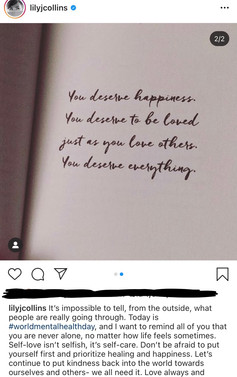
For young people knowing that someone out there, especially someone you look up to, has gone through similar things that you have is comforting. This is what makes the power of social media so important in the 21st century. It allows people to express their feelings and spread awareness on a large scale, as well as build community.
According to a blog post where readers could answer the question “how does social media help with your mental health?” many said that social media “allows [them] to connect with others experiencing the same or similar struggles,” allows them to share their stories, offers an escape from their daily lives, and reminds them that they are not alone (mentalhealth.org.uk).

Furthermore, since the creation of social media and its ability to spread awareness, the stigma surrounding mental health has lessened. In the past, mental health was usually referred to as “mental illness”, whereas now it is about maintaining a mind-healthy lifestyle and doesn’t have such a negative connotation. Social media helps convey to the world that not being okay is okay and things can always get better.
Now, I am not saying that social media can solve the world’s problems because we still have a long way to go with mental health awareness, but social media can help us get there.
Remember, it is perfectly okay to not feel okay.
For more information on Mental Health and Mental Health Awareness visit:
SOURCES:

Comments